
Chesapeake Busted Mugshots Path
Chesapeake stands alone in its jurisdiction. It is an independent city, not a county seat with satellite towns, and the Census Bureau put its population at 254,997 in its July 1, 2024 estimate. Two agencies split the law-enforcement work here. The Chesapeake Police Department handles municipal policing, while the elected Sheriff's Office runs the Chesapeake Correctional Center and keeps the local jail and inmate records.
Arrests by the police that end in local custody go to the correctional center at 400 Albemarle Drive. The Sheriff-linked Tyler inquiry is the official jail-side record, not any municipal arrest feed. Each paper tells a different story. A police incident report, a booking entry, and a court file all answer separate questions about the same event.
Where Chesapeake Busted Mugshots Appear
Official sources come first here. The City posts no daily arrest log and no current-bookings roster. There is no police mugshot feed either. CPD Citizen Connect exists, but it maps crime data rather than tracking bookings. A Chesapeake arrest held in local custody shows up on the Sheriff's correctional-center roster. Its detail view can include a Photos panel. If an online search comes up empty, the City and Sheriff records routes are the fallback.
| Channel | What it covers | Limit |
|---|---|---|
| Sheriff Tyler inquiry | Local booking and current-custody search; detail may show a Photos panel. | Not complete history, and data can change quickly. |
| CPD Citizen Connect | Crime reports and mapping. | Not an arrest roster or booking-photo source. |
| City JustFOIA | City and police-held records requests. | Not the Sheriff’s jail booking record route. |
| Sheriff FOIA | Existing local jail record or adult routine booking photo. | Actual cost and response rules can apply. |
| Recently Booked | Unofficial county-local listing. | Secondary, potentially stale, and not confirmation. |
Secondary sites are leads, nothing more. The project manifest lists a Recently Booked page as an unofficial Chesapeake-local source, so verify anything found there against the jail, the records custodian, or the court. No third-party page replaces an official record.
Busted in Chesapeake Booking Search
Start every current-custody question with the Sheriff's official roster. Search by name, subject number, or booking number. Use the In Custody control for someone held right now. Know a rough booking date? Set the booking-from and booking-to fields to narrow the window. The facility filter picks Chesapeake Correctional Center directly. The form rewards precision. It was never meant to serve as a same-day feed, so treat it as a lookup tool rather than a live stream.
- Open the Sheriff Inmate Lookup and continue to the official Tyler search.
- Compare name, booking number, date, and court fields instead of relying on a name alone.
- For a present custody question that needs a second channel, call the Correctional Center status line at 757-382-2883.
- For a released, historic, or unavailable booking, send a focused Sheriff FOIA request.
- Use the court search to learn what happened after booking.
The wider Chesapeake roster and booking-record treatment fills in what this local search leaves out. It covers date-range quirks, VADOC lookups, federal holdings, retention rules, and feed limits that shape what a visitor actually sees here.
Chesapeake Police Arrest Records
Need paperwork from the police? CPD Central Records keeps the department's files and hands out copies of accident and offense reports. The office sits at 304 Albemarle Drive, Chesapeake, VA 23322. Its phone number is 757-382-6387. For a police report or any CPD-held material tied to a local incident, that is the desk to call. Booking records from the Correctional Center, plus routine adult intake photos, go through the Sheriff's FOIA office instead.
Online, the City takes formal requests through the JustFOIA portal. Other request methods are listed as well. Be specific about what you want. The City requires reasonable detail. Expect the standard Virginia response window of five working days. Fees can apply. No public source lists a special CPD mugshot fee or a firm turnaround time, so ask for an estimate up front.
Chesapeake Police Department Central Records
304 Albemarle Drive
Chesapeake, VA 23322
757-382-6387
Chesapeake Crime Data Is Not Bookings
Crime data and booking data are different animals. CPD's Citizen Connect publishes crime reports and mapping. The agency warns that report review and approval can delay what shows up. City News Flash carries police-featured stories, an Unsolved Crimes section, and a searchable archive. Neither channel is a booking roster. A crime-data point cannot tell you whether anyone was booked, released, or convicted.
The manifest's Citizen Connect capture displays the City-level public data interface. It helps draw the line between the crime-report channel and the Sheriff's booking-search channel.
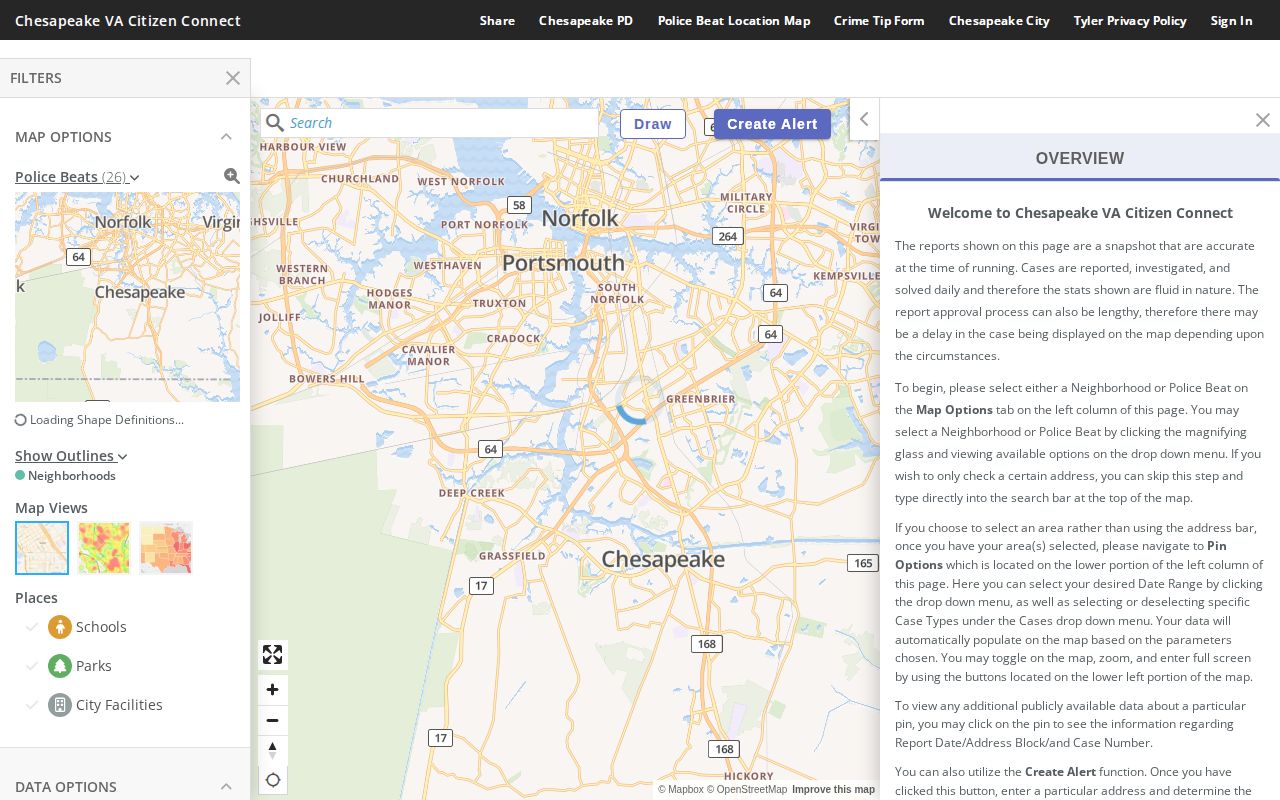
The interface shines at context: reported-crime locations and neighborhood patterns. A named local booking is a different task. Go back to the Sheriff roster for that. Let the court system handle case outcomes.
Chesapeake Busted Intake Timing
Booking at Chesapeake Correctional Center handles arrivals from local, state, and federal jurisdictions. That is the Sheriff's description of the process. So the online entry reflects intake and custody only. It is not the street-level arrest story, and it says nothing about how a case ends. No source gives a fixed window for when a new entry shows up online, so rely on the roster search and its status line instead of any promised posting schedule.
Release timing shifts just as fast. The Sheriff allows bonding around the clock, with a person freed once the Magistrate or courts finish the required paperwork and sign off. A custody result can therefore flip quickly, though no universal release-time estimate follows from that.
Chesapeake Busted News Context
Start with official channels for local public information. City News Flash releases, CPD crime data, and Sheriff public-information posts lead the list. Add a secondary layer too. The WTKR Chesapeake news section carries ongoing local coverage. A story might hand you a date or a name that sharpens an official query. It still cannot stand in for the jail or court record itself.
Coverage moves fast. That speed has a cost. A story may run before a charge is resolved, skip a later correction, or leave unclear which custody system holds the person. Treat no article as proof of where someone sits right now. The Chesapeake crime-news record path shows how to bridge from a headline to official confirmation.
Chesapeake Arrest Court Follow Up
A booking entry is just the first page of a case. Charges get reduced, dismissed, continued, or settled by plea. The roster never says which way things went. To follow the case itself, open the Virginia GDC Online Case Information System and pick Chesapeake General District Court. Adult local criminal and traffic cases are searchable there by party name, case number, or hearing date. Not every category of court information shows up in the system, though.
Both Chesapeake courts sit at 307 Albemarle Drive. General District Court answers at 757-382-3100; Circuit Court at 757-382-3000. When the online result looks thin, a call to the clerk or an official record request fills the gap.
Custody and court status run on separate clocks. Someone can leave the roster after bond, release, transfer, or a sentence while the case is still live in court. The reverse happens too. A live court record does not mean the person sits in the Correctional Center. Chesapeake runs its own police department, Sheriff's office, and courts, so matching the source to the stage saves real time.
Chesapeake Busted Roster Limits
The Sheriff's own caveats matter here. Roster information is updated regularly but can shift quickly. It may also miss a person's true location, status, or release date. The agency says plainly that the roster is not a complete database of all past and present offenders. Bond, transfer, correction, or a legal restriction can all change a result after the fact.
Match any current search result against the booking number, date, and court details when they appear. A released person may vanish from an active-custody filter. Someone moved into state custody may surface through a VADOC locator instead. A federal or ICE question belongs with a different system entirely. No single Chesapeake search settles every question about a record or a location.
Chesapeake Historic Booking Records
Old booking records follow retention rules, not public convenience. The Library of Virginia's GS-08 local-jail schedule sets cumulative booking and release records at 20 years after separation, while inmate incarceration records, which can include booking materials and photographs, last three years after separation. These periods govern internal retention. They promise neither that a person nor an image stays online, nor any permanent public archive.
Chesapeake has no official searchable historic mugshot collection. For an older jail record, open with a specific Sheriff FOIA request. Court papers go to the clerk. A Library of Virginia archives inquiry makes sense only when a custodian confirms a transfer actually happened. Not every old photo lands in an archive.
Know the record type before you ask anyone for it. A court outcome calls for the court route, a former jail booking needs a date or range for the Sheriff, and a police incident report sits with CPD Central Records. Each office applies its own disclosure limits, and none serves as a catch-all archive. State records may rest with a different custodian entirely. Confirm who holds the file before you request it, especially after a transfer or release.